If you’re shopping for someone beginning their French journey or expanding current skills, these gifts support practical learning, daily use, and engaging practice. This guide highlights five beginner-friendly options and explains who each is best for and why it stands out. The focus is on accessible formats—story collections, compact dictionaries, visual dictionaries, flash cards, and short-story readers—that suit different learning styles and goals.
| Product | Best For | Why It Stands Out |
|---|---|---|
| Short Stories in French for Beginners | Readers who enjoy narratives | Structured, level-appropriate stories to build context and vocabulary |
| Merriam-Webster’s Pocket French-English Dictionary | Travelers and quick reference learners | Compact, reliable bilingual reference for on-the-go use |
| French Picture Dictionary Coloring Book | Visual learners and beginners | Large vocabulary through images and activities |
| French Flash Cards | Daily practice and travel prep | Phonetic pronunciations and quick reviews |
| French Short Stories (Beginner to Intermediate) | Progress readers seeking longer passages | More extensive reading to reinforce grammar and vocabulary |
These selections cover varied approaches—from bite-sized vocabulary and pronunciation cues to immersive reading. Each option can be used independently or complemented by simple daily routines, such as 5–10 minutes of flash cards or a short story before bed. Below are detailed profiles to help you choose the right fit for different learning styles and goals.
Short Stories in French for Beginners

Author: Olly Richards (Format: Paperback). Best for readers who prefer narrative practice to build comprehension and vocabulary in context. The stories are designed for beginners to gradually increase exposure to everyday French phrases. This format supports sustained reading with a gentle progression of difficulty. A potential limitation is that readers should supplement with pronunciation practice to maximize speaking confidence. Choose this if the learner enjoys storytelling and wants relatable, culture-rich content.
Merriam-Webster’s Pocket French-English Dictionary

Brand: Merriam-Webster (Editor). Best for quick-lookups while traveling or reading. This pocket-sized dictionary provides concise translations and common usage notes, helping learners verify meanings on the go. A caution: it may not substitute for deeper grammar explanations or specialized terminology. Use this as a reliable reference alongside longer study sessions.
French Picture Dictionary Coloring Book

Brand: Lingo Mastery (Author). Best for visual learners who benefit from images paired with words. The book uses pictures to anchor vocabulary, making it engaging for all ages and suitable for beginners and visual learners. Limitation: it emphasizes vocabulary rather than grammar rules. Choose this if colorful visuals and hands-on activities boost motivation and memory.
French Flash Cards
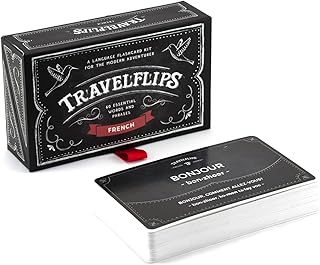
Brand: Travelflips Store. Best for on-the-go practice and daily reviews. Features include phonetic pronunciation and English translations on each card, along with a durable, portable box for easy transport. Limitation: flash cards do not replace structured grammar study or sentence construction practice. Use these to reinforce core vocabulary and pronunciation in short sessions.
French Short Stories (Beginner to Intermediate)

Author: Dylane Moreau (Format: Paperback). Best for progressing readers who want longer readings to reinforce grammar and broaden vocabulary. The stories bridge beginner and intermediate levels, offering more context for language development. A caution: content complexity increases gradually, so learners should pace themselves and revisit earlier sections as needed.
Buying Guide
What learning style fits best?
Visual learners benefit from picture dictionaries and coloring books. Readers who enjoy storytelling should start with short stories. Quick-reference users may gravitate toward pocket dictionaries and flash cards for daily practice. Consider pairing formats for a balanced routine.
How to structure a simple study plan?
- Daily: 5–10 minutes with flash cards or a mini-story excerpt.
- Weekly: 2–3 short reading sessions of a story collection to reinforce new words.
- On the go: carry a pocket dictionary for quick translations and phrases during real-life conversations.
What to look for when buying for beginners?
- Clear pronunciation guides or phonetics on vocabulary cards.
- Progressive difficulty in reading material to gradually build confidence.
- Durable format suitable for travel or classroom use.
How do these options complement each other?
Pair a pronunciation-focused tool (flash cards) with a narrative or picture-based resource for context. Use the pocket dictionary for on-demand help while reading or listening. The combination supports both passive exposure and active recall.
Safety and suitability considerations
Ensure the learner’s interests align with the content style—story-driven, visual, or practical vocabulary. For younger learners, coloring and picture-based options can sustain engagement. For adults, short stories and pocket references may offer more direct applicability to real-life situations.
Language goals and progression
Begin with daily vocabulary acquisition and short readings. Gradually increase reading length and complexity. Track progress by revisiting previously learned words and testing recall with flash cards or quick translations.
FAQ
- Which gift is best for a complete beginner?
Flash cards and the picture dictionary are ideal for initial vocabulary building and visual association. - What should I pick for travel-focused learning?
The pocket dictionary and flash cards are highly practical for quick references and everyday phrases while traveling. - Are short stories useful for improving grammar?
Yes, especially the beginner-to-intermediate story collections, which expose readers to natural sentence structures and contexts. - Is a single resource enough?
Using a combination—such as a dictionary, flash cards, and short stories—provides complementary benefits and supports varied practice styles. - How long should a learning routine last?
Even 15 minutes a day can yield steady progress, especially when combined with diverse activities like reading and flash-card drills. - Do these gifts come with audio?
Some resources may offer audio support; check product descriptions or companion materials for pronunciation practice.